
Insight · Patient experience · Health · Aged care
Flawless Surgery, Brilliant Specialist, and a Hidden Pea in the Patient Journey

Angela Papamarkou
Founder, ARC Narrative · 3 min read

My daughter had her wisdom teeth out a few weeks ago. From a clinical point of view, I'd give the whole thing five stars. Her specialist was excellent and came highly recommended by our own dentist. The hospital staff were kind and efficient. The day itself went off without a hitch.
And yet, sitting in recovery, I found myself thinking about the Princess and the Pea. You'll remember the story: a princess is given the most luxurious bed imaginable, twenty mattresses stacked one on top of the other, and she still can't sleep, because of one tiny pea hidden right at the bottom.
That's what good positioning, good marketing and a genuinely excellent clinical team can look like from the outside. Everything is stacked in the patient's favour. And it can still be undone by something small sitting right at the bottom of the experience, something no amount of clinical skill or clever messaging ever touches.
In our case it was two small things. The first was the appointment time. I'd been given a login for the hospital's pre-admission portal to complete paperwork before the day. When I logged in, the date was there. The time wasn't. No alert, no reminder, nothing telling me when we actually needed to arrive. We've all been trained by our GP clinics to expect a text with a time and a tap to confirm. This was a date on a screen and nothing else. I ended up ringing the hospital to ask something that should have taken ten seconds to find.
The second was smaller again, but it stacked. On discharge, the hospital told me the specialist's clinic would call to arrange a post-operative appointment. When the call didn't come, I rang the practice myself, a little worried. The practice manager was lovely, and a bit surprised, wisdom teeth don't need an in-person follow-up, just a phone check-in a week later. Nobody had done anything wrong. Two different parts of the same patient journey were simply telling me two different things.
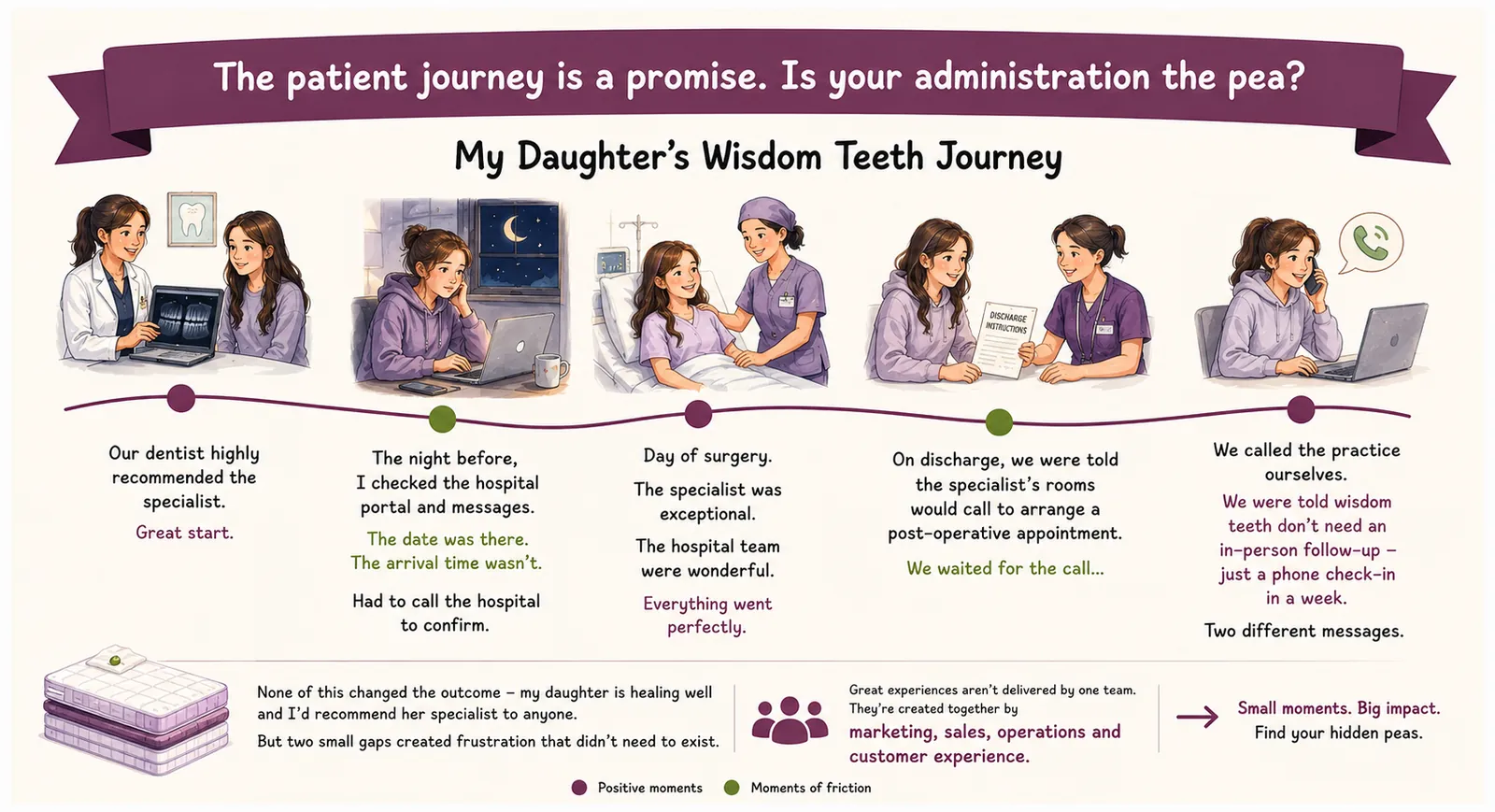
None of this changed the outcome. My daughter is healing well, and I'd recommend her specialist to anyone. But there was a lingering 'but' that didn't need to exist. A parent doing paperwork late at night, hunting for a time that should have been three taps away. A moment of quiet worry over a phone call that was never coming. Neither was a big failure. Together, they were friction a family shouldn't have had to carry through what was already a stressful day.
This is the part I think about professionally. Positioning, clarity and marketing can all be genuinely excellent, and the patient or client experience can still be let down by the small joins in the journey: the handoff between a portal and a phone call, between one team's workflow and another's, between what one part of an organisation tells a family and what another part actually does. Growth and retention aren't only built on the first impression. They're built, or quietly worn away, in the follow-up, the confirmation, the after-hours message, the second phone call nobody expected to have to make.
If you run a practice, a clinic or a health service, it's worth asking where your own pea might be hiding. Not in the big, visible moments that everyone already reviews and reports on, but in the quiet handoffs between systems and teams that nobody owns end to end. The best way to find them is with someone looking at the whole journey the way a family actually experiences it, rather than the way each department sees its own piece of it.
Have someone look at your whole journey from the client or patient's perspective. Find your own hidden peas.
If this sounds familiar and you'd like an outside, objective look at your own patient or client journey, I'd be glad to talk it through.
If this sounds familiar and you'd like an outside, objective look at your own patient or client journey, I'd be glad to talk it through.